
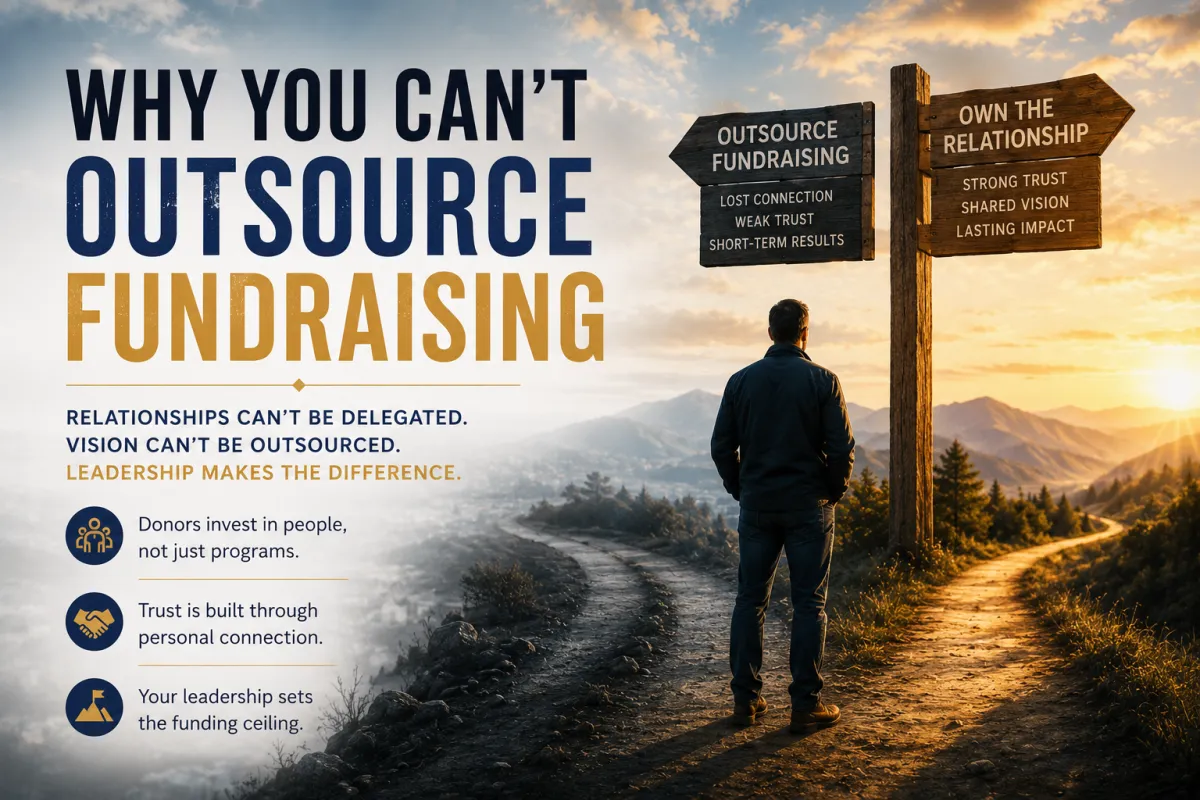
Why You Can’t Outsource Fundraising
One of the most common questions nonprofit leaders ask is:
“Can’t someone else just handle fundraising for us?”
I understand the question.
Most founders and ministry leaders didn’t start their organizations because they loved fundraising. They started because they cared deeply about helping people, solving problems, serving communities, or advancing a mission.
Fundraising often feels uncomfortable, unfamiliar, or emotionally draining.
So naturally, many leaders want to hand it off as quickly as possible.
But after more than two decades of fundraising, leading organizations, and helping nonprofits grow, I’ve learned something important:
You can delegate tasks in fundraising. But you cannot fully outsource the relationships.
And that changes everything.
Fundraising Is Built on Relationships
One of the core principles I teach is this:
Effective and long-lasting fundraising is all about relationships.
Yes, donors support organizations.
But relationships happen between people.
When someone is considering making a meaningful investment into your mission, they are not just evaluating the program.
They are evaluating:
leadership
trust
vision
stability
conviction
They want to know:
Who is leading this organization?
Do they genuinely believe in the mission?
Can I trust them?
Will they follow through?
Will this organization still be healthy five years from now?
Those are leadership-level questions.
And leadership cannot be outsourced.
The Founder Must Own the Relationships
This is why I believe the Founder, CEO, or Executive Director must be the primary fundraiser.
Not because no one else can help.
But because major donors are often giving to the leader’s:
conviction
vision
passion
integrity
leadership
You cannot outsource trust.
You cannot delegate vision.
And you cannot transfer ownership of your most important relationships.
I often use this analogy:
You wouldn’t ask someone else to go on a date with your spouse for you.
You wouldn’t say:
“I’m busy tonight. Could you go maintain that relationship for me?”
But that is often what leaders unintentionally try to do with donors.
Relationships are personal.
And significant partners want meaningful connection with the person leading the mission.
This Doesn’t Mean You Must Do Everything
Now, this is where some leaders panic.
Owning fundraising does not mean you personally do every task.
In fact, one of the healthiest things a growing organization can do is build support systems around fundraising.
You can absolutely delegate:
scheduling meetings
preparing proposals
organizing donor databases
creating presentations
marketing
follow-up systems
thank-you processes
event coordination
I remember periods in our organization where executive assistants and development coordinators handled enormous amounts of logistical work behind the scenes.
They scheduled meetings.
Prepared presentation packets.
Managed calendars.
Coordinated event details.
At one point, a development team even prepared driving directions, donor packets, and meeting materials before a major presentation.
All the leader had to do was walk into the room, share the vision, and build the relationship.
That is healthy delegation.
Support systems should amplify leadership — not replace it.
Where Many Leaders Get Stuck
In my consulting work, I’ve seen many leaders unintentionally stall their organization’s fundraising growth.
Not because they lacked passion.
But because they hoped someone else would handle fundraising for them.
Often, the deeper issue is internal resistance.
Some leaders believe:
“Fundraising feels manipulative.”
“Talking about money feels uncomfortable.”
“If God wants it funded, He’ll provide somehow.”
“I’m not good at this.”
“I don’t want people to think I need help.”
But here’s the reality:
If the leader is hesitant, the organization will be hesitant.
If the leader avoids fundraising conversations, the culture of the organization will avoid them too.
Conviction starts at the top.
The Danger of Outsourcing Relationships
There are many services today promising to “handle fundraising for you.”
Some can absolutely help with:
strategy
marketing
copywriting
grant writing
donor systems
campaign structure
Those things can be valuable.
But if the relationship belongs more to the consultant than to the organization’s leadership, you create a dangerous dependency.
Because when the consultant leaves, the donor relationship often leaves too.
Healthy fundraising builds relationships that stay connected to the mission and leadership — not just to a third party.
Grant Writers Cannot Replace Leadership
I learned this lesson personally.
There was a season where we brought in outside help to support grant writing and fundraising development.
The support itself was valuable.
But we made mistakes when we expected others to fully represent the vision on our behalf.
At the time, we hadn’t clearly developed enough internal clarity around:
mission
vision
strategy
messaging
And because of that, it was difficult for someone else to communicate our vision effectively.
I realized something important:
A grant writer can help prepare proposals.
A consultant can help sharpen strategy.
A coach can help improve communication.
But when it comes to major conversations and significant partnerships, leadership still needs to show up personally.
Fundraising Is Part of Leadership
Many leaders separate fundraising from leadership.
But fundraising is leadership.
If your mission requires people, programs, facilities, staff, outreach, or resources — then funding is part of sustaining the vision God entrusted to you.
That does not make fundraising worldly.
It makes it necessary stewardship.
Healthy leaders do not avoid fundraising.
They learn how to approach it relationally, authentically, and sustainably.
Final Thoughts
If you are a Founder, CEO, or Executive Director, fundraising is not a side responsibility.
It is one of your primary leadership responsibilities.
That may feel intimidating at first.
But the good news is that fundraising is not about becoming someone you are not.
It is about learning how to:
communicate vision clearly
build trust intentionally
invite people into meaningful impact
steward relationships well
You do not need to do everything yourself.
But you do need to own the relationships.
Because fundraising will rarely grow beyond the conviction and engagement of the leader.
And when leadership embraces fundraising relationally instead of resisting it, momentum becomes possible.


