
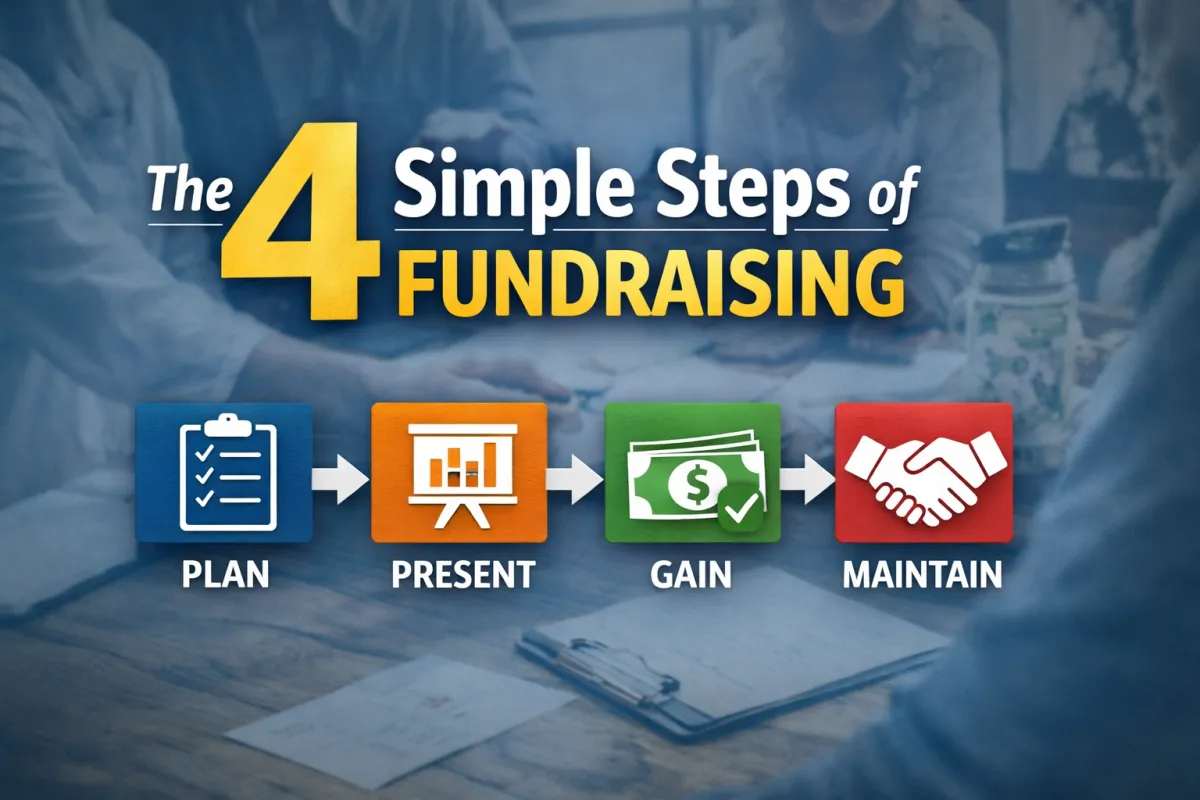
The 4 Simple Steps of Fundraising: Plan, Present, Gain, Maintain
Do you ever feel like fundraising is a complicated beast?
There are so many nuances. Emails. Phone calls. Social media. Meetings. Grant writing.
Maybe you avoid fundraising because you don’t know where to start.
Maybe you hope it will all work itself out.
But hope is not a strategy.
The good news is that fundraising is not nearly as complicated as it may seem.
In reality, there are four basic steps to fundraising:
Plan — Present — Gain — Maintain
Everything in fundraising falls into one of these four categories.
I’ve been involved in fundraising most of my life. I’ve been making presentations for more than 25 years. I’ve raised millions of dollars, led organizations, and worked across multiple nonprofit sectors. I’ve raised money from individuals, businesses, and foundations for many different types of projects.
Over time, I’ve learned that while fundraising contains many nuances, success almost always comes back to mastering these four steps.
If you understand the foundation, you gain structure.
Structure brings clarity.
Clarity builds trust.
And when trust is established, people give.
Let’s take a deeper look at each step.
STEP 1: PLAN
Don’t skip this step.
Planning is critical before you can effectively present. If you don’t clearly understand what you are doing, you won’t know what you need.
There are four key areas that must be established during the planning phase.
Mission
Your mission defines why you exist. What purpose does your organization serve? What problem are you working to solve?
An example mission might be:
To alleviate food insecurity in our city.
Vision
Vision gives direction. It paints a picture of the future you want to see.
For example:
A vision could be that no one in your city goes without at least one meal in a 24-hour period.
Core Programming
Core programming is the vehicle that moves your mission forward and makes your vision possible.
It answers the question: What do we actually do?
There are many ways to address food insecurity.
Examples might include:
A food pantry
A soup kitchen
A meals program
But there are also creative approaches.
You might organize a network of families willing to host individuals at their dinner tables each evening. Or you might partner with local restaurants, creating a meal voucher system where people in need can redeem tickets for meals.
Each of these approaches would require different levels of funding and would be presented differently when raising support.
That’s why defining your programming during the planning phase is so important.
Budget
The final piece of planning is your budget.
If you don’t know what it costs to operate your programs, you won’t know what to ask for.
Your budget should include:
Direct program costs
Facility costs (rent or ownership)
Administrative expenses
Other operational needs
Once this phase is complete, you will be ready to present.
And when you have clarity about what you are doing and what it costs, you will present with confidence.
Clarity produces trust.
And effective fundraising is built on trust.
STEP 2: PRESENT
Every fundraising presentation must answer five questions:
Who are you?
What are you doing?
Why is that important?
What are you asking for?
Why does it matter to the person you’re asking?
If these questions are not clearly answered, your presentation will struggle.
Using the food insecurity example, a simple presentation might sound like this:
"My name is Taran, and I work with XYZ Organization. We are a local nonprofit focused on eliminating food insecurity in our city. Our vision is that no one in our community goes without at least one meal each day.
One of the ways we are addressing this is through our evening meals program. Across four locations, we provide meals for more than 500 people each night.
This program is important because many of our neighbors don’t have stable housing. Without a place to store or cook food, traditional food pantry support doesn’t fully meet their needs.
This program costs about $10,000 per month to operate, and we currently have half of that funded through committed monthly partners.
We are looking for people who would consider joining us by contributing $500 per month toward this program.
I know you care deeply about our community and about helping people who are struggling. Many people see the problem but don’t always know the best way to make a real difference. This program is one of the most direct ways to help ensure our neighbors don’t go hungry.
Would you be open to partnering with us?"
That entire presentation takes less than two minutes.
Of course, you could add details or share a story from someone impacted by the program. But the key is that each of the five questions is clearly answered.
One of the most important parts of this step—and the one many leaders avoid—is the ask.
You must clearly invite people to participate. Tell them what you need and give them an opportunity to respond.
STEP 3: GAIN
This is the step where someone actually gives.
A check is written.
A credit card is processed.
A commitment is made.
Sometimes this happens immediately after the presentation.
But often, gaining is a process.
It may take multiple conversations and follow-ups before someone decides to partner with you.
I once had a donor help fund the construction of a school and then provide monthly support to operate it for an entire year. But that commitment didn’t happen in the first conversation.
It started with an introduction through another supporter. Then there was an email. Then a phone call. Then a follow-up conversation.
It was during our third interaction that they made the commitment.
Fundraising is relational. Relationships develop over time.
STEP 4: MAINTAIN
This is the step many organizations overlook.
Once someone gives, the relationship should not end.
In fact, it should deepen.
Send a handwritten thank-you card.
Check in periodically.
Meet for coffee.
Celebrate impact together.
Too often, organizations think:
"They already gave. Let’s go find someone new."
But over 25 years of fundraising, I’ve consistently seen that well-maintained relationships generate far more support than constantly chasing new donors.
I remember one donor who initially gave a small gift early in our organization’s history. Over time, they connected us with other organizations they were involved with. Those connections began supporting the work as well.
More than ten years later, what began as occasional $500 gifts grew into multiple six-figure contributions each year.
That growth came through relationship.
The Simplicity Behind Successful Fundraising
Fundraising may feel complicated, but the structure is simple.
Plan — Present — Gain — Maintain
Master these four steps and your fundraising efforts will become much more effective.
I’ll be sharing much more about these principles—and the practical ways to implement them—in a book I’ll be publishing soon.
In the meantime, you can explore more leadership and fundraising content on my YouTube channel.
I’d love to hear about the work you’re doing and the challenges you’re navigating.


