
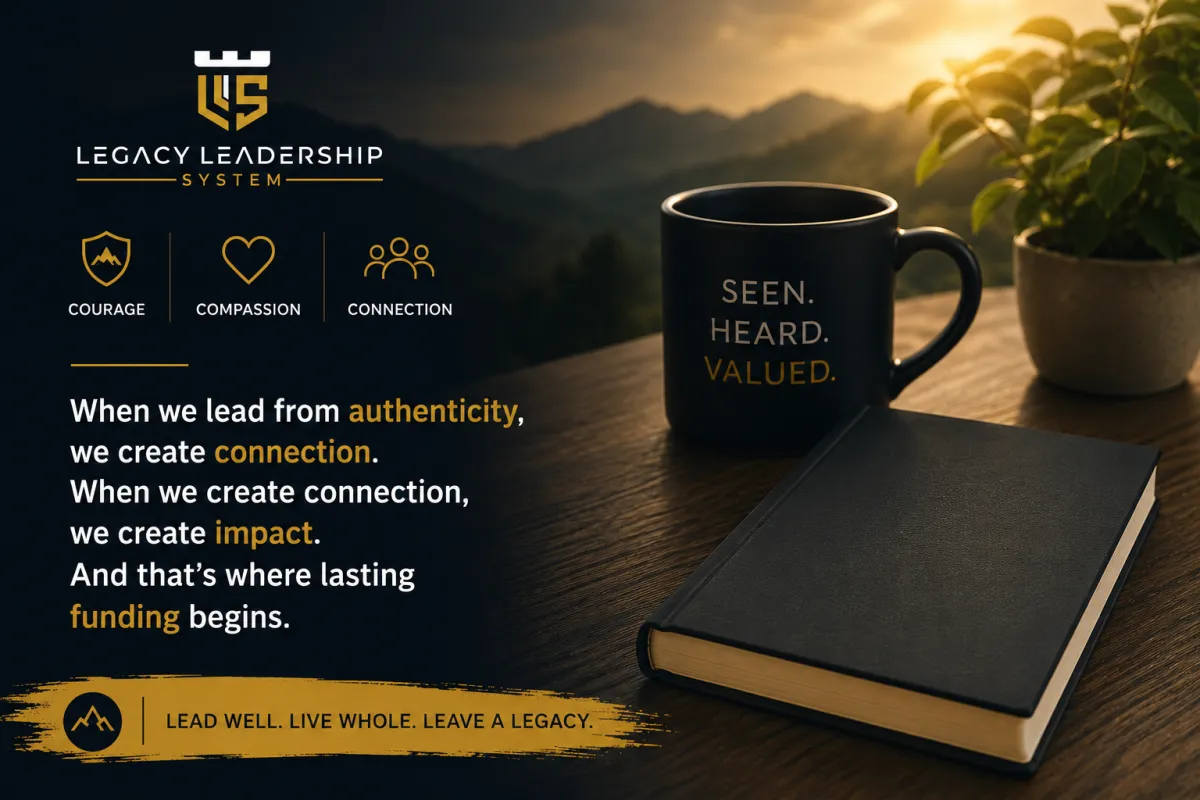
Why Authenticity Matters in Leadership and Fundraising
One of the books I recently finished reading was The Gifts of Imperfection by Brené Brown.
While the book isn't specifically about fundraising, I found myself highlighting passage after passage that directly applies to leadership, relationships, and the way we connect with others.
At its core, the book explores what it means to live wholeheartedly—to embrace who we are rather than constantly striving to become who we think others want us to be.
For leaders, that lesson is incredibly important.
Because whether we are leading a family, a business, a ministry, or a nonprofit, our ability to connect with others will often determine the impact we are able to make.
Courage, Compassion, and Connection
One of the central ideas Brené Brown shares is that wholehearted living is built on three things:
Courage
Compassion
Connection
What struck me most is that these qualities are not things we simply think our way into.
They are things we practice.
You learn courage by acting courageously.
You learn compassion by showing compassion.
You learn connection by reaching out and connecting with others.
The same principle applies to leadership.
Many leaders wait until they feel confident before they take action. But confidence often comes after the action, not before it.
I often see this in fundraising.
Leaders tell themselves:
"I've never raised a large gift."
"I've never secured a major donor."
"I've never done this before."
The reality is that no one has—until they do.
The first large donor comes after the first conversation.
The first successful fundraising presentation comes after the first attempt.
Growth happens through practice.
The Foundation of Connection
One definition from the book stood out to me:
Connection is the energy that exists between people when they feel seen, heard, and valued.
Think about that for a moment.
Seen.
Heard.
Valued.
Those three words have enormous implications for leadership.
Many people approach fundraising as if it is about getting something from another person.
But healthy fundraising isn't built on taking.
It's built on connecting.
When someone feels genuinely seen, heard, and valued, trust begins to grow.
And trust is the foundation of every meaningful relationship.
The strongest donor relationships I've ever had were never built around money.
They were built around connection.
The donation came later.
Fitting In Versus Belonging
Another concept from the book that challenged me was the distinction between fitting in and belonging.
Brené Brown explains that fitting in is becoming who we think we need to be in order to gain acceptance.
Belonging, however, requires us to be who we actually are.
I think many leaders struggle with this.
We try to become what we think donors want.
We adjust our personality.
We change our language.
We try to present a version of ourselves that seems more acceptable.
But eventually that becomes exhausting.
If your fundraising depends on pretending to be someone else, it isn't sustainable.
The people who are meant to partner with your mission don't need you to become someone different.
They need you to show up authentically.
They need to trust the real you.
Self-Acceptance and Leadership
Authenticity begins with self-acceptance.
Many leaders spend their lives battling internal messages that say:
I'm not enough.
I'm not qualified.
I don't know what I'm doing.
Someone else could do this better.
Those thoughts affect more than confidence.
They affect how we show up.
They affect how we communicate.
They affect our willingness to lead.
I was challenged by the idea that many of us speak to ourselves in ways we would never speak to another person.
We extend grace to others.
We encourage others.
Yet we criticize ourselves constantly.
Healthy leadership requires learning to extend some of that same compassion inward.
Incongruent Living Is Exhausting
One phrase I highlighted in the book simply said:
"Incongruent living is exhausting."
I couldn't agree more.
Whenever we try to live outside of who God created us to be, it drains us.
When we constantly perform, pretend, or wear masks, leadership becomes exhausting.
Fundraising becomes exhausting.
Relationships become exhausting.
But when we lead from authenticity, things begin to align.
We stop trying to earn acceptance.
We stop trying to fit in.
We stop trying to become someone else.
And we begin leading from integrity.
Fear, Joy, and Scarcity
Many leaders carry tremendous pressure.
I understand that pressure.
I've led organizations where hundreds of employees depended on funding.
I've worked with thousands of children whose education depended on resources being available.
The responsibility can feel overwhelming.
When that pressure builds, fear often follows.
Fear tells us:
There won't be enough.
What if the money doesn't come?
What if I fail?
What if I let people down?
The problem is that fear creates scarcity.
And scarcity closes us off.
Fear causes us to pull back.
Fear makes us smaller.
Fear limits possibility.
Joy does the opposite.
Joy opens us to possibility.
Joy invites connection.
Joy allows us to approach people with confidence and hope.
Healthy fundraising grows when leaders operate from purpose and possibility rather than fear and scarcity.
Meaningful Change Is a Process
One of the final reminders from the book is that meaningful change takes time.
Awareness comes first.
We notice the patterns.
We identify the limiting beliefs.
We recognize the habits that are holding us back.
Then we begin the process of change.
Not overnight.
Not instantly.
But one step at a time.
As leaders, we often expect ourselves to arrive immediately.
But growth rarely works that way.
Whether you're becoming a stronger leader, a better fundraiser, or a healthier person, remember that transformation is a process.
Give yourself permission to grow.
Give yourself permission to practice.
Give yourself permission to be imperfect.
Because courage, compassion, and connection are not destinations.
They are habits we cultivate over time.
And those habits ultimately allow us to lead well, live whole, and leave a legacy.


